Showing posts with label Public Health. Show all posts

Monday, August 18, 2014

Six Months and Counting...

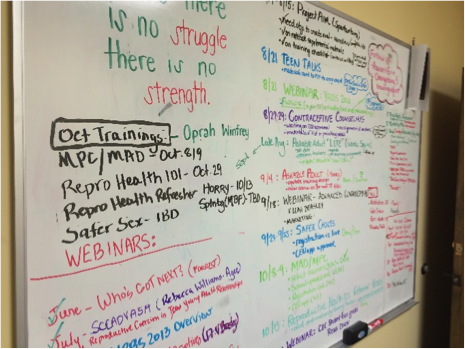
So, next Tuesday marks my six month milestone with the SC Campaign. And those months have flown by. It’s been a busy time at the SC Campaign. Our 20th Anniversary Gala, followed quickly by Summer Institute, sprinkled in with Contraceptive Counseling, ICE, Seventeen Days, Reproductive Coercion, Leadership, Be Protective, Social Media and youth, training trips to San Antonio and Knoxville…WOW!! Busy is an understatement. And the fall looks even busier! I’m still learning about CEUs, nursing CEUs, MAPPS hours and all of the different processes we go through to get these approved. I’m so very thankful to all of our partners for their patience as I learn and adjust. And I’m especially thankful for Markessce Craft and Sara Lamberson for helping with all of the logistics.

We are excited about several new trainings we are offering this fall:

Along with some great standards:
  • Making a Difference/Making Proud Choices
  • Safer Choices
  • Reproductive Health 101 
Check out our events page on our website for more information about all of our workshops, and keep checking as we are adding more to our calendar daily.

by Shannon Lindsay, Training Coordinator, SC Campaign to Prevent Teen Pregnancy

Monday, June 23, 2014

Getting to Know our Priority Youth Specialist Rena Dixon

I sat down with Rena Dixon, Priority Youth Specialist at the South Carolina Campaign to Prevent Teen Pregnancy to learn more about how she became a public health professional.  Rena has worked for the SC Campaign for four years and recently earned her Ph.D. in Community Health Promotion and Education from Walden University.

Kemi:  Describe your journey to becoming a public health professional focused on teen pregnancy prevention.

Rena: I went to undergrad thinking I was going to be an athletic trainer – very different from what I do now. They discontinued the athletic training program at my school so I had to figure out what I was going to do. At my school, you were put in health science classes to be pre-athletic training, or pre-nursing, or pre-physical therapy, so I stuck with my public health classes and I loved it. I absolutely loved it, it was great.  I did my internship with young people in the Housing Authority [of Savannah] so I really bought into working with young people, which led to my first job working at Planned Parenthood in Georgia. I learned all about pregnancy prevention, STIs, and working with young folks.  I moved away from that and really wanted to get back into it, which is why I made the switch to come back to working in sexual health all day every day.

Kemi: So, young people – that was really your driving point?

Rena: Right. I really wanted to be a person that was a resource for folks about health information.  You see so many people who don’t know the right answers or don’t know how to get the information. I thought it was really important to me as a person of color to be that voice for my own people, and my own neighborhood, and my own family. So I just kind of took off with it.

Kemi: That kind of makes me think of Beverly Bond’s talk [at Summer Institute 2014] where you’re kind of waiting for somebody else to do it [be a resource in your community then decide] I’ll just do it [instead] because other people are probably thinking the same thing, that we need so-and-so to be a role model. 

Kemi: Can you describe a typical day being a Youth Specialist?

Rena: I travel a lot. A typical day usually involves me being in the car going somewhere to meet with our providers that we work with. I do have a unique position that I work with providers all across the state and not in one particular region.  So, any given day I could be in Spartanburg, or I could be in Horry, or I could be in Charleston, or I could be in Lancaster or Rock Hill. But a typical day involves me driving to see one of our clinic partners or higher ed partners.

Kemi: So, when you say our providers, you’re talking about mostly clinics?

Rena: Yes, my position is specialized to really focus on working mostly with clinic providers to help increase their capacity to provide teen-friendly services for youth coming in, or I work with higher ed campuses to help them address teen pregnancy on their campuses.

Kemi: So, have they heard of us, or you just go in and you give them [information]?

Rena: Ninety percent (90%) of the people I work with closely are receiving some type of grant funding through us or we’re working with them on a particular project like the BlueCross BlueShield project, or the CDC project, or the PREP project, or now the PAF project. So, they’ve already been identified to work on that larger sub-project and I’m just doing my piece for that grant.

Kemi: So, how did you spend this morning?

Rena: I was doing a speaker request for a group of about 300 young people on pregnancy prevention and STIs.

Kemi: Do you do these often? Is it usually that large of a group?

Rena: Well, it’s kind of random. I think it’s always different for us because we don’t do direct service, but people still look to us to provide education and information in communities. So I do feel like we get a lot of speaker requests. Those of us in the office who are public health trainers and are comfortable getting up in front of groups usually get those requests. I did one two weeks ago and one about six months ago. It varies.

Kemi: Do you prepare a PowerPoint, or what do you do to keep young people engaged?

Rena: I did a Prezi this time because there were so many young people, I felt like I needed some visuals and I think that’s a cool, different way instead of a boring PowerPoint. Two weeks ago, I did a game with the young people because I had a smaller group of about 30, and I did two different sessions so I was able to use a game called Fact or Fiction.

Kemi: Are they [young people] pretty responsive?

Rena: Yeah, they are.  You get a lot of questions.  A lot, a lot of questions because some people don’t have anyone they feel comfortable talking to, or someone they can talk to who’s going to give them the right information.


Wednesday, August 22, 2012

Nowadays, they do more than talk on that phone...


As a mom of a two and a half year old, I have come to appreciate my smart phone - sometimes it's my only hope if I want to have a productive trip to the grocery store. Lucas loves the apps that are helping him learn his shapes, alphabet, colors, numbers and more. He is even better than I am at games like Angry Birds and Temple Run - it’s amazing how quickly he has picked up on  technology and the way he can navigate through my phone. But, his favorite app is YouTube because he can look up silly videos about trains or monster trucks and watch some of his favorite shows like Pokoyo and Spiderman.

However, as we all know, there is a lot of material on YouTube that you don’t want your toddler viewing. So, as a parent, I strictly monitor what Lucas is watching and playing with on my phone. Granted, he is two, but I think it is becoming increasingly important for parents of children of all ages to know what their kids are up to on their cell phones.


A new study by the National Campaign to Prevent Teen and Unplanned Pregnancy says that 20% of teens are now sexting – the practice of sending sexually explicit text messages to others. Because of my job this didn’t surprise me too much, but as a mother I hope this news will serve as a wakeup call to parents. Yes, I know teens need their privacy, and when Lucas gets to that stage in his life where he wants to go to his room and shut the door, I will come to grips with it. But, what teens also need is a parent – a parent who cares enough about their child to take a look at his/her text messages; a parent who cares enough to sign up for Facebook so they can monitor what is happening on their son/daughter’s page. A parent who cares enough to have difficult conversations.

No, as parents we aren’t always going to be our kids’ best friend. At times, they may really resent us; but I think that is what being a parent is all about. I remember times growing up when I thought, “my parents just don’t understand” or “this is so unfair”, but looking back, I now know it was called love. My parents cared enough about me and my future to set boundaries, to check in on those boundaries, and to talk to me about my friends and boyfriend (who is now my husband J).  
Teens are going to make mistakes along the way; heck, adults are going to make plenty of mistakes, but if I can educate my child on our family values, on the ways that improper use of cell phones and social media can hinder him from reaching his goals; I am going to do it – even if he doesn’t want to hear it.

By Cayci Banks, Director of Communications for the SC Campaign to Prevent Teen Pregnancy

(Editor’s “Cheeky” Note: Someone in the Royal Family should care enough too! Latest scandal with Royal Family and Prince Harry is enough to show how dangerous data plans and camera phones can be! Don’t be like the Royals…keep up with your kids and teach them responsibility with their online presence!)

Monday, June 25, 2012

More than a number...


 A couple starts going to therapy to work on their troubled relationship. The therapist asks the couple separately, "how often do you have sex?" The wife responds to the question "ugh, all the time...3 to 4 times a week" and the husband separately responds "hardly ever, only 3 to 4 times a week."


The story above is a great example of how data can be the same in value but completely different in context.  It is important to understand what numbers mean and not just understand the value of the data.  For instance, the newly released summary of the national Youth Risk Behavior Survey (YRBS)[1] shows the percentage of students engaging in various risk behaviors including “never wore a bicycle helmet” and “in a physical fight on school property one or more times.” At first glance, the national findings may seem “normal” but when compared to the state of South Carolina, the findings paint a different picture.[2] 

·       *Nationally, 47% of high school students have ever had sexual intercourse.  That means that almost 5 out of 10 high school students have ever had sex.  This alone seems like a big number.  However, when compared to the percentage in South Carolina, this number doesn’t seem as large because 57% of high school students in the state have ever had sexual intercourse.  That means that in South Carolina, almost 6 out of 10 high school students have ever had sex.

·       Nationally, 15% of high school students have had sexual intercourse with four or more persons.  This is a certainly a cause for concern, however the findings in South Carolina are even more disturbing.  In South Carolina, 21% of high school students have had sexual intercourse with four or more persons. 

·         Nationally, 34% of high school students had sex three months prior to the YRBS survey.  This percentage doesn’t seem as bad when compared to South Carolina, where 42% of high schools students in the state had sex three months prior to the survey.

All of the above comparisons are examples of how data can be interpreted when we don’t take in account the context of the data.  It is important to also define “good” and “bad” so that when you first look at a number like “3 to 4” you can better understand whether that is “good” or “bad.”  When looking at the findings from the YRBS, one way to see how South Carolina students are doing in terms of their sexual behaviors is to compare the state to the nation or to other southern states.  Understanding the context helps someone better identify whether a number is “good”, “average” or “below average.”  The “average” can change from year to year or from state to state depending on the context of the data. 

I leave you with this thought: my husband is an avid outdoorsman and has been trying for years to get me to also love the outdoors.  I recently went fishing and caught a 1lb catfish that fought me like a 90 pound golden retriever.  I was beyond thrilled when I eventually pulled up the fish and thought that I deserved an Olympic medal.  My husband, who was excited that I was excited, was less impressed with my small catch.  He has caught fish over 60 pounds so to him a 1lb fish was considered bait fish.  So as you interpret data as “good”, “bad” or “average”, be sure that you understand the difference between the “bait fish” and the “big one.” 


[1] Centers for Disease Control and Prevention (CDC). Youth Risk Behavior Surveillance: United States, 2011. MMWR 2012;61(No. SS-4):1-162.
[2] Note – the findings from the YRBS have been rounded.

Wednesday, June 20, 2012

Talking "the Talk"...


As someone who came into this field knowing very little about public health, I like to think I have learned quite a bit over the last five years and even have the talking points down pat, but having a son of my own, I have realized that it is much easier to talk the talk than it is to walk the walk.
What do I mean? Well, it is very easy to tell the public that parents are the number one influence on their children's decisions about love, sex and relationships. Very easy to tell parents they need to start conversations early and have them often. Very easy to tell parents to use teachable moments as a way to have ongoing conversations.

What's not so easy is when it's your own child and mine is only 2! But I am taking the advice of my colleagues and literally practicing what I preach.
Over the last couple of months I have come to realize that even for toddlers, teachable moments abound. In full disclosure, there is really no private time for mommy, so when Lucas follows me to the bathroom he has many questions - like why Mommy doesn't stand up or my favorite, "mommy, oh no, your penis is gone!!!" But, thanks to my job, I am equipped to use these moments to teach Lucas about body parts (so proud that he knows the real names) and how boys and girls are different, instead of shying away and avoiding his questions.
Believe me, I know the questions are going to get harder, but my hope is that they don't stop coming. I want Lucas to feel comfortable talking with me about tough topics and hopefully by "starting early" that will be our reality.

by:  Cayci Banks, Director of Communications, cbanks@teenpregnancysc.org.

Wednesday, April 25, 2012

A Perfect Fit: Teen Pregnancy Prevention and Public Health

Usually when I tell people that I work in the field of public health, they naturally assume that I focus on physical fitness, diet and nutrition (these are obviously not the people that know of my love for Little Debbie Swiss Rolls).  However, people normally do not assume that my focus is in teen pregnancy prevention.  Why is it that people do not connect the dots between public health and unintended teen pregnancy?  Teen pregnancy is associated with multiple social issues impacting the public health of a community, family and individual.  Teen pregnancy is linked to foster care, early birth weight, premature birth, receiving welfare, and lowered educational achievement, just to name a few.  Here are the facts:
  • Young teen mothers (17 and younger) are 2.2 times more likely to have a child placed in foster care than mothers who delay childbearing until age 20 or 21.
  • Teen mothers ages 18-19 are about one-third more likely to have a child placed in foster care than mothers who had their first child at age 20 or 21. 
  •  Infants of teen mothers are at increased risk of being born prematurely.
  •  Almost half of all teen mothers began receiving welfare within five years of the birth of their first child.
  •  Parenthood is the leading cause of school dropout among teen girls. 
  •  Children of teen mothers are 50 percent more likely to repeat a grade, less likely to complete high school and have lower performance on standardized tests. 
  •  Less than half of mothers age 17 and younger ever graduate from high school.
 Additionally, teen pregnancy impacts the physical, emotional, psychological and financial health of the teen mother, teen father, involved families and community.  April is Public Health month, followed by Teen Pregnancy Prevention month in May.  So this spring as you are watching young people enjoy some of the pivotal “firsts” in their lifetime such as going to prom or walking across the stage to accept their diploma, consider that in 2010 there were 6,847 teens (15-19 years old) who gave birth in South Carolina, putting them at an increased risk for drop out and the other negative societal issues as listed above.
So why should we consider teen pregnancy as a critical part of addressing public health?  Because the impact on the community, family and individual IS public health.

By Sarah Kershner, It's Your Game Project Coordinator at the SC Campaign to Prevent Teen Pregnancy, Sarah can be reached at skershner@teenpregnancysc.org. This blog was also featured in the National Public Health week blog.

Wednesday, November 9, 2011

My Trip through the APHA Expo Hall: Where Theory Meets Practice

From October 29 – November 2, 2011, APHA’s held its 139th Annual Meeting & Exposition in Washington, DC. APHA stands for the American Public Health Association which, I believe, is the largest organization of public health researchers and professionals in our country. Over 13,000 people reportedly registered to attend APHA this year. One of those persons was myself, the Training Coordinator for the SC Campaign. While I grew up near Washington, D.C., and lived there as an intern in 2007, I was not prepared for the experience about to take place. I truly believe anyone who works in the field of Public Health should attend APHA at least once. You need to see with your own eyes, the scope and scale of this conference. Imagine how Dorothy felt when seeing OZ for the first time.

When I first arrived at the Washington, D.C. Convention Center (which takes up two full city blocks) – I followed the crowd and signs up to the third floor where I registered with a swipe of my conference issued ID card. That’s right, you don’t just get a name badge, they give you an ID Card (I’ll explain why in a minute). They handed me the conference program with the complete list of presentations, poster sessions, meetings, caucuses, meet n’ greets, and vendors was 418 pages long. “That’s not a program,” someone remarked to me, “it’s a phone book.” Good thing they gave us an APHA branded recyclable shoulder bag to carry the book and other items.

Then I took a walk through the Expo Hall. Now “hall” is a deceiving term, think more like airplane hanger, or better yet, picture a sci-fi movie with spaceships landing in a spaceport. That’s the size and scale of this room. APHA reported that over 650 businesses had spaces in the Expo Hall, but from where I stood, it looked like thousands of booths!
(pictured: The Centers for Disease Control and Prevention (aka CDC) station featuring national and global health projects)
Overwhelmed by the scale of the spaces, I quickly retreated to a couch in the internet lounge (offering free Wi-Fi) so that I could review my conference ‘phone book’ (I mean, program) and chart my course for the next few days. I planned out each day, where I would be every 1-2 hours. There were 30 minute breaks between sessions, which seems like a long time but with long walks across the building, lines for coffee/food, and the time it took to find the closest restroom, 30 minutes seemed barely enough time to get a good seat in the next session.

The scientific presentation sessions were just that - very scientific. The opportunity to hear from expert researchers in the field was eye-opening but often over my head since everyone who knows me, knows that research isn’t my cup of tea. I like to read the executive summaries at the beginning of each journal article, and I’m infamous for skimming through a 30 page report in too short a time. I’m sure others in the field of teen pregnancy prevention can relate, while others who love research and data are saying “shame on you, Ryan.”

So after hours of sessions – hearing lots of theory and tons of data points, regression models, p values, etc.... it was time for me to rerevisit the “spaceport” (I mean, Expo Hall). The Expo Hall was alive with activity. The loud speaker announced upcoming book signings and raffle drawings for those who had visited 24 premiere vendor books and gotten a stamp from each on their conference ‘passport’. There were booths from most of the major universities and schools of public health in the country. Students looking for advanced degrees or graduates looking for employment stopped from station to station. My favorite was a booth set-up like a living room and the admissions staff invited you to have a chat on their sofas.

The next row over, there was a mobile dentist office in a converted RV set-up complete with a LCD TV on the side showing educational videos about oral hygiene. One booth featured the APRIL aging software that helps you see what you will look like at 72 if you eat unhealthy foods, smoke, or tan without UV protection. Trust me, the smoking, tanning, fast food eating Ryan at 72 is NOT someone I hope to ever become… There was one vendor that asked us to take off our shoes and stuck special support cushions in there, before you knew it, they felt so good you almost gave them $38 to keep them in your shoes – but I resisted their sales ploy. If you saw a vendor who you liked and wanted more information from, you could give them your ID card and with one swipe, you were added to their mailing list. Goodbye age of business cards – hello digital age!

The thing about the Expo Hall that I liked the most was that the vendors weren’t just selling junk or giving away useless information. Every single booth was there for a reason! This was public health theory in its most practical form. Research had been conducted, theories had been developed and from those theories, products were create and now either being given away, raffled off, or sold. This Expo Hall was a place to find the latest demonstration models for those working in nutrition and healthy eating, software for those conducting qualitative interviews, services to help you translate documents or in real-time into over 160 languages, and the vendors that caught my attention most – companies or non-profits related to HIV and Teen Pregnancy prevention.

I filled my conference bag with condom samples and models of IUDs, brochures, and postcards. I spoke to national organizations and groups local to Washington, D.C. I visited the booths of ETR, Select Media, the CDC, and Health and Human Services (HHS). These practical tools that I gathered at the conference now rest on shelves in my office, spread across my desk, and distributed among my coworkers at the SC Campaign. From what I learned and gathered at APHA, we can now bring some of the theories home to South Carolina and some of the practice recommendations home to you at your agency or directly into the places where your kids will learn how to be better prepared for adulthood.

I’m glad I took a stroll through the ‘spaceport’ to collect stamps for my 'passport' with my ‘phone book’ under my arm. It was worth every minute I spent in the Expo Hall at APHA!

-Ryan Wilson, MEd., is a Training Coordinator for the SC Campaign to Prevent Teen Pregnancy. Contact Ryan at  rwilson@teenpregnancysc.org (803) 771-7700 ext. 126.